

Don't Blame Your Team.

Blame Your Persona.

Your generic buyer definition is costing you sales.


We build the specific one that changes behaviour.


Your marketing team is running campaigns nobody asked for. Your sales team is chasing the wrong opportunities. Your product team is building features for buyers that do not exist.


The problem is not incompetence. The problem is that your persona is generic.


  • Generic enough that a competitor could use it.
  • Generic enough that every team member interprets "the buyer" differently.
  • And when you are not aligned on who you are selling to, you are not selling. You are just loud.


This costs you sales. It also costs you credibility internally.


A real Ideal Customer Profile is specific enough to change behaviour. Specific enough that your whole team sees the same person when they close their eyes.


That is what we build here.

Two people sit at a computer workstation, one pointing at complex data on the screen while the other types on a keyboard.

Generic Personas Cost You Deals


You probably have a persona already. You probably spent money on it. And unless you built it right, it is leaving money on the table.


Here is what a generic persona looks like:

"Sarah is a VP of Marketing. She is between 35 and 50. She is digital-forward. She needs tools that integrate with her stack."


This describes thousands of people. Your competitor is probably selling to the same profile. Your message has nowhere to land.


A real ICP is different. It is specific enough to change your behaviour. It has:


  • The exact job title and reporting line. Not "VP of Marketing" but "VP of Demand Gen at a Series B SaaS company hitting $10M ARR."
  • The specific pain that keeps them awake. Not "needs integration" but "is losing deals to competitors who show up earlier in the research phase."
  • Who influences the decision and why. The CTO, because she does not trust marketing to evaluate technology.
  • What success looks like to them. Shorter sales cycles, not faster software.
  • How they actually make decisions. Quarterly reviews with the CFO, not when budget opens up.


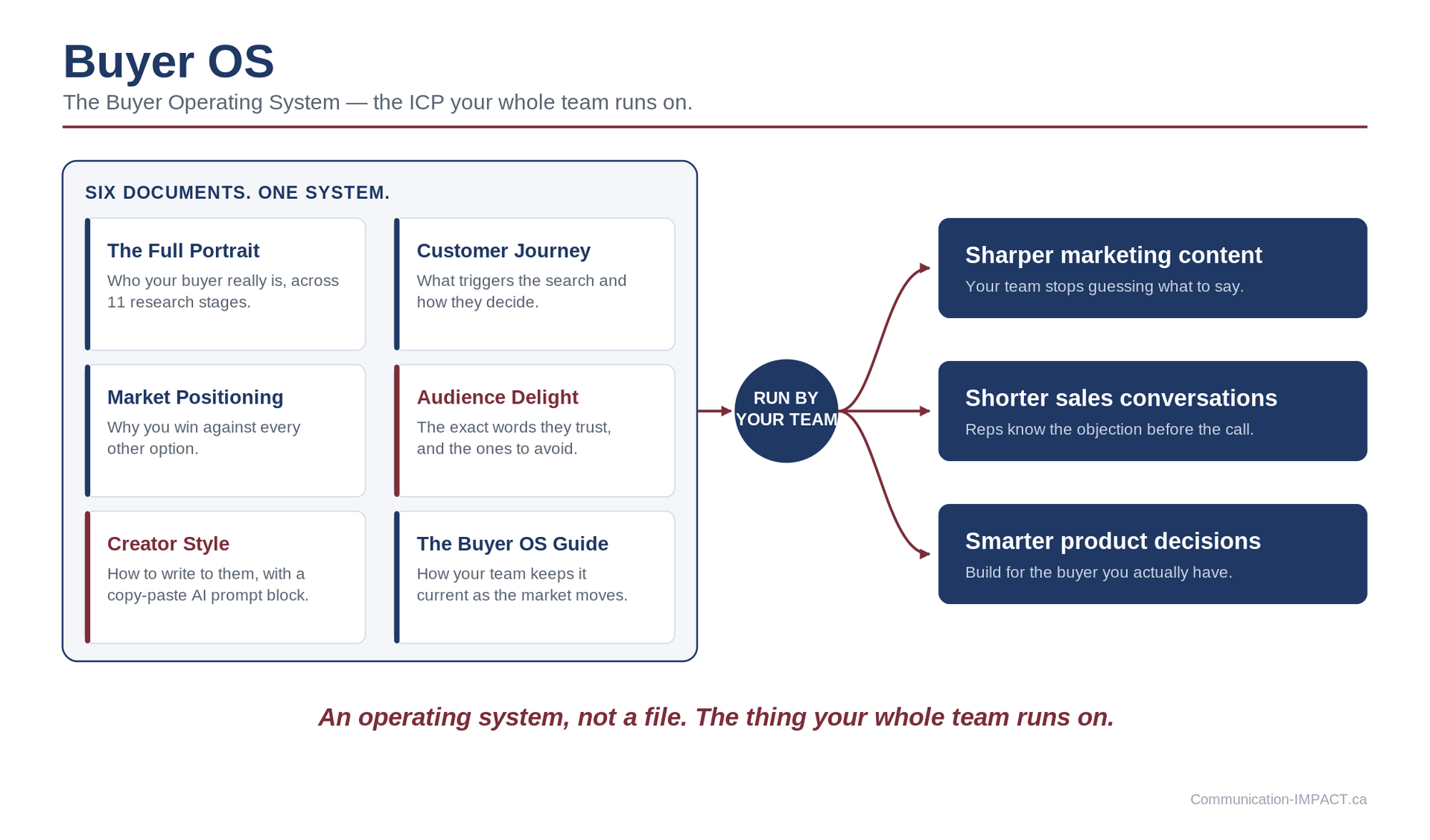
When your team operates from that level of specificity, everything changes. Your messaging gets sharper. Your targeting gets tighter. Your sales conversations get shorter.


Most importantly, your team stops guessing.

Three Paths — One Framework


Whether you are a founder finding your first buyer, a SaaS company trying to scale predictably, or a manufacturer who is invisible online — the problem is the same. And the solution is the same.

1.   For Founders & Startups


You're Burning Cash on the Wrong Buyer


You have a product. You have conviction. And you are spending money on customer acquisition without actually knowing who your customer is.


Most founders are guessing. They say things like "We think small agencies are our buyer" or "We're targeting VP-level marketers." That is not a customer profile. That is a hope.


Here is what happens when you operate on hope:


  • You build features for buyers that do not exist.
  • Your messaging is so broad it lands with nobody.
  • Your first 10 customers came from your network or luck, not repeatability.
  • You cannot explain to an investor why THIS company should buy from you instead of that company.
  • You burn cash finding customers instead of building a repeatable motion.


By the time you realize your assumption was wrong, you have already spent the runway.

The founders who win do something different. They get specific. They answer these questions with precision, not assumptions:


  • What specific job does your buyer have? Not "VP of Marketing" — "VP of Demand Gen reporting to the CMO at a Series B SaaS company hitting $10M ARR."
  • What is the one problem they cannot solve without you? Not "needs marketing automation" — "cannot fill the pipeline because her buyers research for 4 months before talking to a vendor, and she has no way to influence that research."
  • Who has to agree before they buy? The CTO. Why? Because she does not trust marketing to evaluate tools. The CFO. Why? Because she wants proof of ROI.
  • What does their day look like when the problem is not solved? They manually manage three different spreadsheets. They miss signals about what buyers are looking at. They pitch to buyers who are 80% decided on a competitor.


When you can answer these questions, everything changes. Your first customer was luck. Your tenth customer proves you understand the market. Your hundredth customer proves you have a business.


An ICP is the tool that gets you from luck to repeatability.


Investment: This engagement typically falls in our Tier 1 range: $1,500-$3,500 depending on complexity and your current stage.

2.   For Established SaaS Companies


You're Spending Like You're Winning. You're Not.


You have product-market fit. Your Annual Recurring Revenue (ARR) is growing. Your marketing budget is growing. And your cost per acquisition is growing faster than both.


You are also losing to competitors you should crush. Smaller companies. Companies with inferior products. Companies that show up smarter, not bigger.


Here is what is usually happening at your stage:


  • Your personas are too broad. You are trying to sell to "any marketer" or "any VP of Sales." So your messaging is generic.
  • Your targeting is scattered. You are in every LinkedIn campaign, every ad platform, every conference. You are loud. You are expensive.
  • Your sales team is chasing logos instead of picking customers. They are in deals they should lose.
  • Your internal teams are not aligned. Marketing is promoting "ease of use." Sales is selling "integration depth." Product is building "customization." You are three different companies.


The winners at your stage are doing something completely different. They are saying NO to some deals so they can say YES to the ones that matter. They are NOT trying to sell to everyone. They are choosing their customer.


A real ICP at this stage changes your behaviour across the entire company:


  • Marketing stops casting a wide net. You are not "reach marketers in SaaS." You are "reach VP of Demand Gen at Series B companies in the $5-15M ARR range." Now your messaging is specific. Now your targeting is tight. Now your spend is efficient.
  • Sales stops chasing logos. They know exactly what a qualified prospect looks like. They know the questions to ask in the first call to determine fit. Their sales cycle gets shorter because they are only in deals with real buyers.
  • Product stops guessing. They are not building "features marketers asked for." They are building "the research workflow that solves for the exact way this specific buyer discovers solutions." Now product decisions are informed.
  • Your messaging gets sharper. You stop talking about what you do. You start talking about the specific problem this specific buyer has and why it matters to their business.


The cost of not doing this? You are burning budget on the wrong deals. You are in 30% more sales cycles than you should be. Your close rate is lower. Your payback period is longer.


An ICP stops the bleeding. It forces you to choose your customer. And the moment you choose, everything gets better.


Investment: This engagement typically falls in our Tier 2 range: $5,500-$9,500 depending on the number of personas and depth of research.

3.   For Manufacturers & Industrial Companies


You're Invisible in the Moment That Matters Most


You build better equipment than your competitors. Your service is stronger. Your reliability is proven. And newer competitors with inferior products show up online and get the meeting.


By the time your rep picks up the phone, 70% of the decision is already made. And you were not in that conversation.


Your buyer was doing research you could not see. They were reading articles. Watching videos. Comparing specifications. Talking in industry forums. Building their own shortlist. And if you were not visible in that window, you did not make the cut.


This is not about your product. Your product is good. This is about your visibility in the buying journey.


The other problem nobody talks about: your buyer is not one person. It is a committee.

The plant engineer wants reliability. The operations manager wants uptime. The procurement person wants price. The CFO wants ROI. The plant superintendent wants ease of installation.


Most manufacturers treat the sale like one person makes the decision. So they build messaging for one buyer. So they miss the other four people who have veto power.


When a buying committee is not aligned, the deal stalls. Or it dies. Or you win the deal at a lower price than you should.


Here is what changes when you map your buying committee:


  • You show up where your buyer is researching. Not where you think they research. Where they actually research. Then you are visible.
  • You answer the questions each committee member is asking. The engineer is asking "Will this integrate with our existing system?" The operations person is asking "What is the mean time between failures?" The CFO is asking "What is the ROI and payback period?" You build content and messaging for each of those questions.
  • You change your sales approach. Your rep is no longer selling to the plant manager. Your rep is facilitating a conversation between four people who all need different information.
  • Your deal cycles get shorter. When everyone on the buying committee has the information they need, they do not stall waiting for internal alignment. The decision moves forward.
  • You win more deals at better margins. You are not competing on price because you are the only one visible early.


An ICP for manufacturing is not a persona. It is a map. A map of your entire buying committee. How they research. Where they research. What questions each one is asking. How they make decisions together.


When you have that map, you become visible before the call.


Investment: This engagement typically falls in our Tier 2 or Tier 3 range: $6,500-$15,000+ depending on buying committee complexity.

What Makes This Different?

This is Not a Document But Rather a Transformation


A lot of people offer persona templates. A worksheet. A PDF that looks nice and changes nothing because it sits in a Google Drive next to 47 other PDFs nobody reads.


This is different.


Here is what actually shifts when you have a real ICP:


Your team stops guessing.

Before: Your marketing team and sales team are operating from two different definitions of "the buyer." Product is building features for a buyer they invented. Everyone is confused.

After: Your whole team sees the same person. They can articulate that person. When everyone sees the same thing, the confusion disappears. The contradictions disappear. The wasted effort disappears.


Your messaging gets specific.

Before: Your website says "We help marketers be more effective." So does every other company. Nobody remembers you.

After: Your messaging is "We help VP of Demand Gen at Series B SaaS companies fill their pipeline before buyers even know they are researching." Now your message lands. Now prospects see themselves.


Your targeting becomes precise.

Before: You are running ads to "anyone in marketing." Your CAC is high. Your ROI is unclear.

After: You know exactly who your customer is. Your targeting gets tighter. Your cost per acquisition goes down. Your payback period gets shorter.


Your sales cycles get shorter.

Before: Your sales team is in 30% more deals than they should be. The sales cycle drags.

After: Your sales team knows what a real opportunity looks like. Their sales cycle is shorter. Their close rate is higher. Their time is spent better.


Your product decisions are informed.

Before: You are building features because "customers asked for it" or "the loudest person asked for it." You are guessing.

After: You are building features that solve for the specific problem your specific buyer has. Your roadmap is clear. Your development effort is focused.


Your whole company is aligned.

Before: Sales is compensated on revenue. Marketing is measured on leads. Product is evaluated on features shipped. Everyone is pulling in different directions.

After: Everyone is focused on one customer. Everyone is trying to solve for the same person. Sales, marketing, and product are not at war. They are on the same team.

Three Tiers. Built For Where You Are Right Now.

An Investment in Clarity


An ICP is not a cost. It is an investment in clarity. Clarity in your messaging. Clarity in your targeting. Clarity in your team alignment. Clarity in your sales.

Tier 1:   Founder ICP / Essential ICP


For:

Founders who need to know who they are selling to. SaaS companies starting the segmentation process. Manufacturers just beginning to understand their buying committee.


What You Get:

  • One fully developed persona (11-stage buying journey)
  • Customer research or market research (depending on where you are)
  • Four go-to-market templates: messaging guide, content topics, sales conversation framework, research sources
  • One 30-minute follow-up call (to answer first-week questions)


Investment:

$1,500-$7,500 depending on segment


Founders/Startups: $1,500-$3,500 | SaaS: $5,500 | Manufacturing: $6,500


Time Commitment from You:

8-15 hours over 3-4 weeks (Intake interview, feedback on research, review of deliverables)

Tier 2:   Full ICP Suite / Growth ICP


For:

Companies ready to go deeper. You are scaling, you want to understand your secondary buyers, you want to align your team.


What You Get:

  • Two to three fully developed personas (each with 11-stage buying journey)
  • Customer research interviews (we talk to your best customers)
  • Team enablement session (30 minutes — we walk your whole team through what we found)
  • Go-to-market templates customized for each persona
  • Pricing strategy guidance (which personas are worth more)
  • Two follow-up calls: Week 2 (30 min) and Month 2 (30 min)


Investment:

$5,500-$9,500 depending on segment


SaaS: $7,500-$9,500 | Manufacturing: $8,000-$9,500


Time Commitment from You:

20-35 hours over 6-8 weeks (Intake interviews, customer research interviews, team session, reviews and feedback, implementation work)

Tier 3:   Strategic ICP Engagement / Launch-Ready ICP


For:

Companies who want to transform their go-to-market. You want a buying committee map. You want content strategy built from the ICP. You want messaging frameworks embedded into your systems.


What You Get:

  • Three to four fully developed personas (each with 11-stage buying journey)
  • Buying committee map (decision-maker identification, influencer mapping, veto points)
  • Comprehensive customer research (interviews with your best customers)
  • Full go-to-market strategy: messaging architecture, content roadmap, sales playbook, channel strategy
  • 60-minute launch session with your whole team
  • Two follow-up calls over 60 days: Week 2 (30 min) and Month 2 (30 min)


Investment:

Custom pricing based on complexity (typically $12,000-$20,000+)


Time Commitment from You:

35+ hours over 8-12 weeks (Extensive customer interviews, team sessions, internal alignment meetings, implementation)

Retainers - Maintain Your Advantage


Markets shift. Competitors evolve. Your ICP needs a refresh.


Many companies add a retainer after the initial work:


  • Quarterly Persona Refreshes: $1,500-$2,500/month
  • Monthly 30-minute strategy call
  • Quarterly deep dive on market shifts and persona evolution
  • Access to updated research
  • Help embedding ICPs into new hires and processes

Ready To Stop Guessing About Your Buyer?


The next step is simple. A 30-minute conversation.


We talk about where you are right now. What your buyer looks like to you. What you have tried. What is not working. Then I tell you which tier makes sense and why.


No pitch. No deck. Just a conversation between two people who know marketing.


If we are a fit, we start. If we are not, I will tell you that too.

Schedule a Discovery Call


Schedule a Discovery Call Today

Or email mj@communication-impact.ca with questions about which tier is right for you.


FAQ's found below:

Buyer Persona Development FAQs.

  • How long does developing an ideal customer profile actually take?

    Depends on the tier. Tier 1 is 3-4 weeks. Tier 2 is 6-8 weeks. Tier 3 is 8-12 weeks. You are doing work on your end (interviews, feedback, reviews), so the timeline is shared. Most of that time is consumed with getting customer interviews scheduled.

  • Do you interview my customers?

    Yes. That is how we find the real patterns. We talk to your best customers to understand what they have in common, how they actually buy, what kept them from your competitors initially, and what made them choose you. Those conversations are worth more than any template.

    We also talk to your customer-facing team members for additional insights.

  • What if we are early stage and do not have customers yet?

    We do market research instead. We talk to prospects, we talk to your competitors' customers, we interview industry experts. The output is the same: a specific ICP based on real market data, not assumptions.

  • Do you deliver a one-pager or a full brief?

    Both. You get a comprehensive research brief (15-20 pages depending on tier) that your whole team can dive into. You also get a one-pager summary for quick reference and sharing with new team members.

  • Can we change the ICP after we get it?

    Absolutely. The research is the foundation. But markets change, competitors move, your business evolves. The tier 2 and tier 3 retainers include quarterly refreshes to keep it current. You are not locked into anything.

  • What if we want to expand to other markets or geographies?

    We build in your primary market first. You can add markets later as a separate project or fold it into a retainer. The process is the same, but the research is market-specific.

  • How is this different from just hiring a consultant for a day?

    A day of consulting is surface-level advice. This is research-backed specificity. We are not telling you what we think your buyer is. We are showing you what we found by talking to real people. That is the difference between guessing and knowing.

  • What if we disagree with the findings?

    That conversation is important. Usually, disagreement means we found something you did not expect. That is valuable. We will walk through the research with you, show you who we talked to, show you the patterns we found. Then you decide what to do with it. I am not here to convince you. I am here to show you what the market is telling us.

  • Can you work with our sales team directly to implement this?

    Yes. In Tier 2 and Tier 3, we run team enablement sessions. Your sales team gets trained on how to use the ICP in actual conversations. The follow-up calls often include sales team members so they can ask questions about the research and how it applies to deals they are working.


  • What's included in the follow-up calls?

    Depends on the tier. Tier 1 gets one 30-minute call to answer first-week questions. Tier 2 gets two calls: one at week 2 (clarification and implementation questions) and one at month 2 (how is it working, what needs adjusting). Tier 3 gets deep dives at week 2 and month 2 focused on strategy refinement and embedding into your systems. These are not check-ins. They are working sessions.


  • Do you provide training for our whole team?

    Yes, for Tier 2 and Tier 3. Tier 1 does not include team training. Tier 2 includes a 30-minute team enablement session where we walk your marketing, sales, and product teams through what we found. Tier 3 includes a 60-minute launch session plus ongoing support.


  • How do you measure success?

    We measure whether the ICP changes your behaviour. Did your messaging get sharper? Did your sales conversations get tighter? Did your sales cycle get shorter? Did your team stop debating who the buyer is? Those are the metrics that matter. If you are using the ICP and it is working, then it worked.

  • What if our sales team doesn't buy in?

    That usually means they do not understand it yet. That is why the team enablement session exists. We sit down with them and show them how the ICP solves problems they are actually facing in deals. The magic usually happens when they realise the ICP explains deals they lost. Suddenly they are believers.

  • How often should we refresh our ICP?

     At minimum, annually. Quarterly is better if your market is moving fast. If your product changes significantly or your competitor landscape shifts, refresh immediately. The retainer option includes quarterly refreshes so you never get stale.


  • Can you help us present this to our board or leadership?

    Yes. Tier 3 includes a 60-minute launch session with your whole team. I can also help you structure a board presentation if you need it. The ICP is a boardroom conversation — it shows you know your market, you have a clear target, and you are focused.


  • Title or Question

    Describe the item or answer the question so that site visitors who are interested get more information. You can emphasize this text with bullets, italics or bold, and add links.
  • What's the typical timeline from first conversation to deliverable?

    From the moment we start research to the moment you get the full brief: Tier 1 is 3-4 weeks, Tier 2 is 6-8 weeks, Tier 3 is 8-12 weeks. But the first conversation (the discovery call) happens before any of that. We just need to understand where you are and what you need.


  • What if we want to test this before committing to a full tier?

    Start with Tier 1. It is the smallest investment ($1,500-$7,500 depending on your segment). You get one real persona and the research behind it. You get to see how we work. Then you can decide if you want to expand to Tier 2. No long-term commitment. No surprise fees.


  • Do you provide templates or frameworks we can use internally?

    Yes. Every tier includes templates. Tier 1 includes four: messaging guide, content topics, sales conversation framework, research sources. Tier 2 and 3 expand those and include buying committee maps, content roadmaps, and sales playbooks. You own all of it. You can use it, modify it, share it with your team.


  • How do you handle confidentiality?

    Everything you tell us is confidential. Everything we learn about your customers is confidential. We sign NDAs if you need us to. Your competitive information, your revenue numbers, your customer names — all of it stays between us. That is table stakes.


  • What if we decide to pivot our target market mid-project?

    Tell us. We adjust the research focus. Pivots happen. It is not a problem. We just need to know early so we are talking to the right people.


  • Can we do multiple personas in parallel or do we have to do them sequentially?

    Tier 2 and 3 cover multiple personas in one project. We do them in parallel, not sequentially. That is why Tier 2 is 6-8 weeks instead of 3-4 weeks per persona. It is more efficient and keeps your whole team aligned on all buyers at the same time.